
 MADE IN EUROPE
Service System: management that makes the difference
A complete system that supports each serial number throughout its entire lifecycle:
from creation through the management of service and maintenance activities, with integrated intelligent features.
Ideal for machines and complex products.,
but also for standard production.
Key strengths
Discover the key benefits
Its advantages:
- Reduced intervention times
- Higher customer satisfaction
- Complete traceability and team coordination
- Optimized spare parts management
- Better maintenance cost control
Is a Service System also useful for companies that produce made-to-order machinery?
Yes. It is particularly useful because it allows you to track each individual machine installed at the customer site, manage its serial number, service history, and plan specific maintenance activities for each plant.

ERP + Service: integration between the two systems
Smoother processes and greater control, from ticket to invoicing
The ERP is the “economic governance system,” while the Service System is the “operational engine of service,” and their integration allows them to work as a single unified flow.
In summary:
-
ERP: Its purpose is to ensure control and planning of company resources, with a strong focus on administrative processes and the “internal” management of the business.
-
Service System: it is a platform specialized in after-sales technical service management. It focuses on field operational activities such as technical interventions, scheduled and unscheduled maintenance, help desk/customer care, as well as back-office activities like remote support and the management of ticketing, spare parts, and documentation.
When integrated, they continuously exchange information.

Omnichannel communication
Profile-based portals and multi-channel communication
The SolidRules Service System extends customer support beyond the company boundaries through dedicated portals for customers, dealers, and service centers.
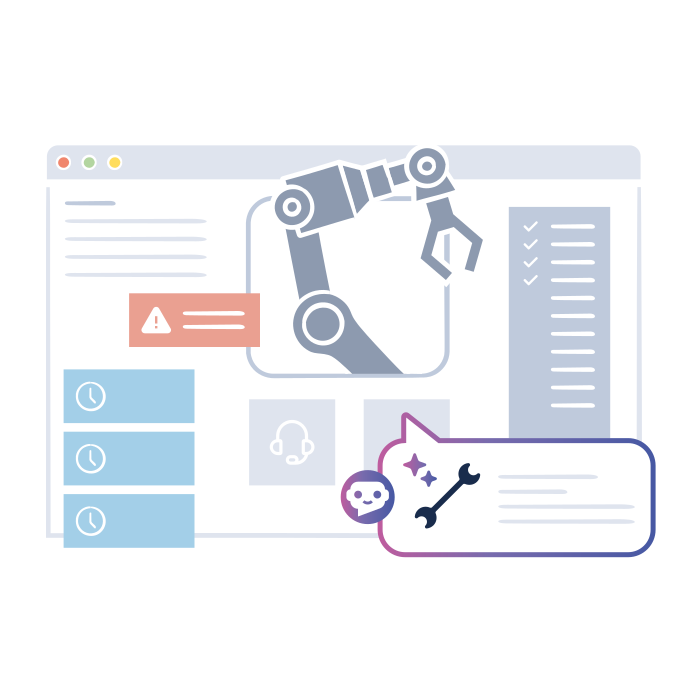
Through a single profile-based interface, each user can access their information, open tickets, consult documents, and track request progress.
Communication takes place across multiple channels - email, web forms, chat, WhatsApp, or Telegram - to ensure maximum responsiveness. In this context, artificial intelligence has evolved the product towards new capabilities:
 The AI-powered virtual assistant provides instant support 24/7, reducing unnecessary ticket creation and preserving company know-how through centralized knowledge management.
Product catalog
Complete traceability of information
The management of serial numbers and product codes through a centralized Catalog is the foundation of an effective and structured service operation.
Each product installed at customer or dealer sites has a complete record, including technical documentation and multimedia content.
Integrated with the Catalog, the warranty portal allows users to monitor coverage status, register activations, and manage any extensions in a simple and immediate way.
The core of Service remains the intelligent management of requests, complaints, and reports. Through customizable templates, it is possible to open and track any type of ticket, from technical requests (direct issuance of ECR/ECO) to non-conformities (Quality Management), ensuring full visibility over every step. Each ticket is linked to company entities (documents, codes, projects, serial numbers, contacts) and managed through configurable workflows and automation.
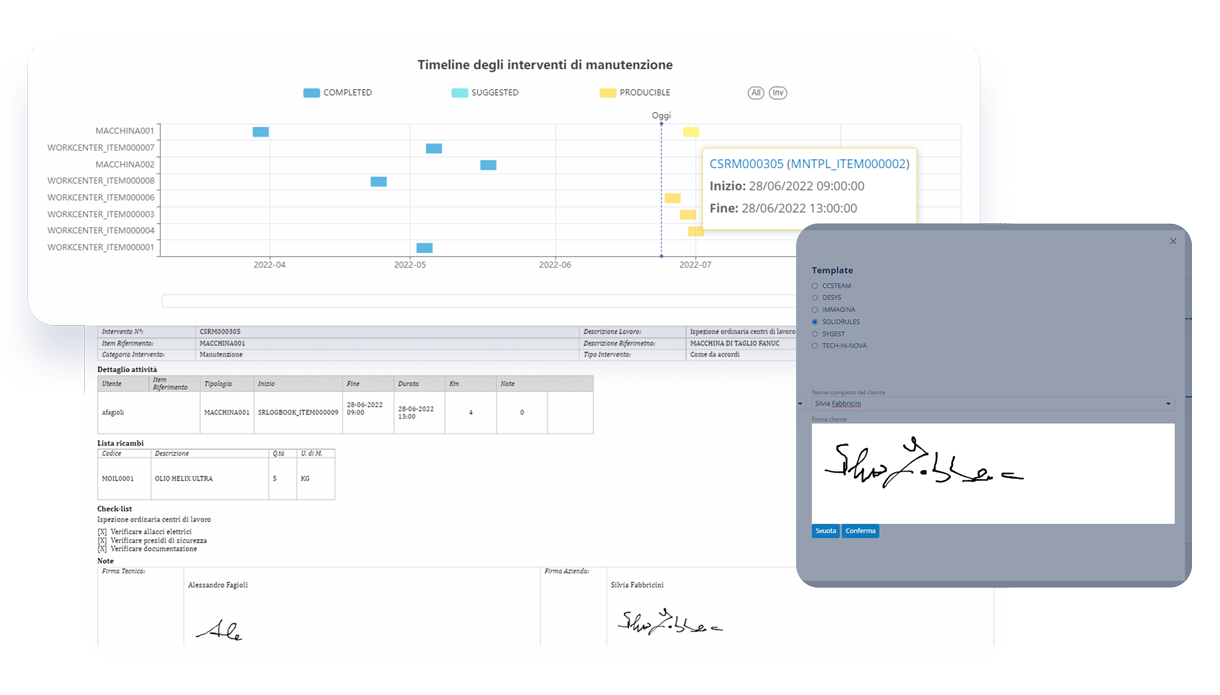
All information and activities remain fully traceable within the system, which evolves into a true integrated Document Management System (DMS) with Project Management capabilities: shared calendars where all technical interventions are scheduled, including service reports that can be filled in and signed even offline.

Reduce intervention times and errors thanks to always up-to-date information.
Choose SolidRules for a tangible advantage
The added value of the Service System is its ability to integrate with PDM and PLM environments.
Information quality
Integration makes it possible to connect product technical data with service activities, improving the quality of information available to technicians and ensuring consistency across design, production, and service.
Always-available technical data
In practice, product technical data (drawings, bills of materials, revisions, configurations, specifications) managed in PDM systems and within PLM environments also becomes available during the Service phase. This means technicians can always work with up-to-date and consistent information, reducing errors, misinterpretations, and the use of outdated documentation.
The advantage? Information continuity
The advantage is not only operational: it creates information continuity across the entire product lifecycle. Information collected during service activities can also flow back to design and production, enabling continuous product improvement.
Spare parts
Spare parts portal: visual and intuitive
The SolidRules spare parts portal enables fast and reliable identification and ordering of components.
2D and 3D views, automatically generated from CAD geometry, allow a graphical multi-level navigation of the bill of materials. In this context, we refer to SBOM (Service-BOM).
It is possible to manage kits, alternative components, and place orders directly from the cart, integrating functionalities typically found in a B2B2C portal.
Integration with the ERP system provides real-time information on stock levels, prices, and costs, reducing errors and machine downtime.
Strategic data analysis
IoT for performance analysis: from data to continuous improvement
The Service module communicates directly with field products thanks to IoT integrations.
Machines interact with the platform, transmitting operating data and alarms in real time.
The collected data is analyzed to identify critical issues, predict failures, and optimize maintenance through Predictive Maintenance.
Full control of your machines: SolidRules supporting your business strategy
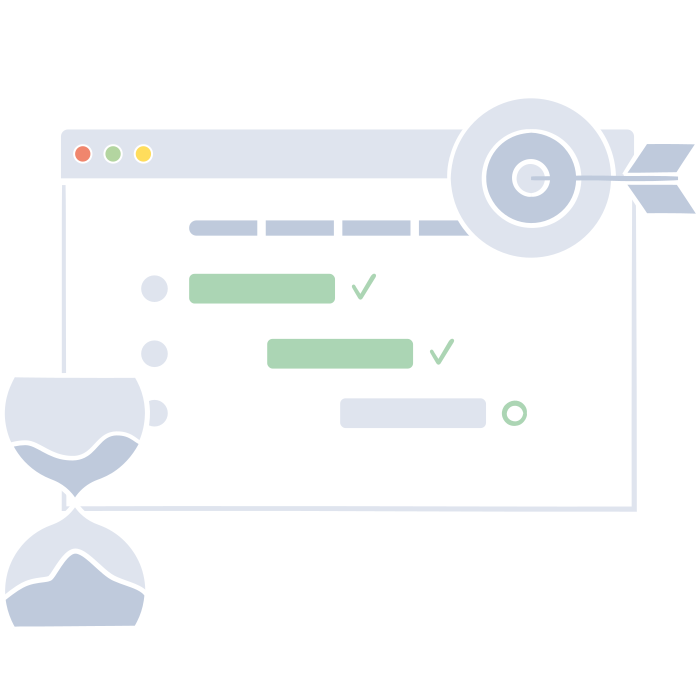
Customizable dashboards with relevant KPIs allow you to monitor service response times, providing a complete overview for faster and more targeted decision-making.
Integrations
With everyday tools such as +50 ERPs, Microsoft Outlook / Office 365, or Google Calendar. Project management in SolidRules Desk is fully self-contained, while still enabling import and export communication with PDM and PLM systems.
Who is it for
SolidRules is a system designed to meet the needs of companies that provide service to their customers, as well as organizations that rely on internal maintenance teams to manage in-house service operations and work centers.
Frequently asked questions
-
1. How does SolidRules help plan maintenance activities?
SolidRules automatically schedules both routine and corrective maintenance activities based on customized maintenance plans. The system takes into account deadlines, resource availability, recommended spare parts, and standard intervention times. This enables service teams to work more efficiently while reducing unexpected issues and delays.
-
2. Can maintenance activities be scheduled automatically?
Yes. The system allows preventive maintenance and recurring service activities to be scheduled automatically based on due dates, operating hours, machine cycles, or other custom parameters. Automated scheduling helps reduce machine downtime and improves overall service organization.
-
3. Can service activities be managed from smartphones or tablets?
Yes. Technicians can access documents, bills of materials, work instructions, and machine information directly from smartphones, tablets, or PCs. Thanks to the SolidRules app, machines and serial numbers can be quickly identified using QR codes or RFID technology. Customer signatures can also be collected directly on the tablet at the end of the service intervention.
-
4. Does SolidRules Service System integrate with other business software?
SolidRules is designed to integrate with existing business applications such as ERP systems, Microsoft Outlook, Microsoft 365, and Google Calendar. Most importantly, service interventions can be automatically transferred to the ERP system for invoicing. This eliminates duplicate work and keeps all departments aligned with the latest information.
-
5. Can the complete service history of installed machines be managed?
SolidRules enables companies to track serial numbers, machine configurations, warranties, maintenance activities, and spare parts used throughout the entire machine lifecycle. Having a complete service history simplifies maintenance management and improves the quality of customer support.
Any question? We are here for you.
Fill out the form or send us an email to info@solidrules.com. We will contact you to provide you all the solutions.