
 MADE IN EUROPE
Intelligence, Our Way
Today, anyone who wants to integrate external Artificial Intelligence tools, like ChatGPT or others, can do so easily: SolidRules allows connection to any AI system.
But this isn’t the only path. There’s another way, the one we envisioned.
A present built on local intelligences, safer, more sustainable, and autonomous, where:
1. AI is based on a local model
2. Data always stays within the company
3. There are no costs for each query to third-party services
AI for Advanced Search – Ask SolidRules
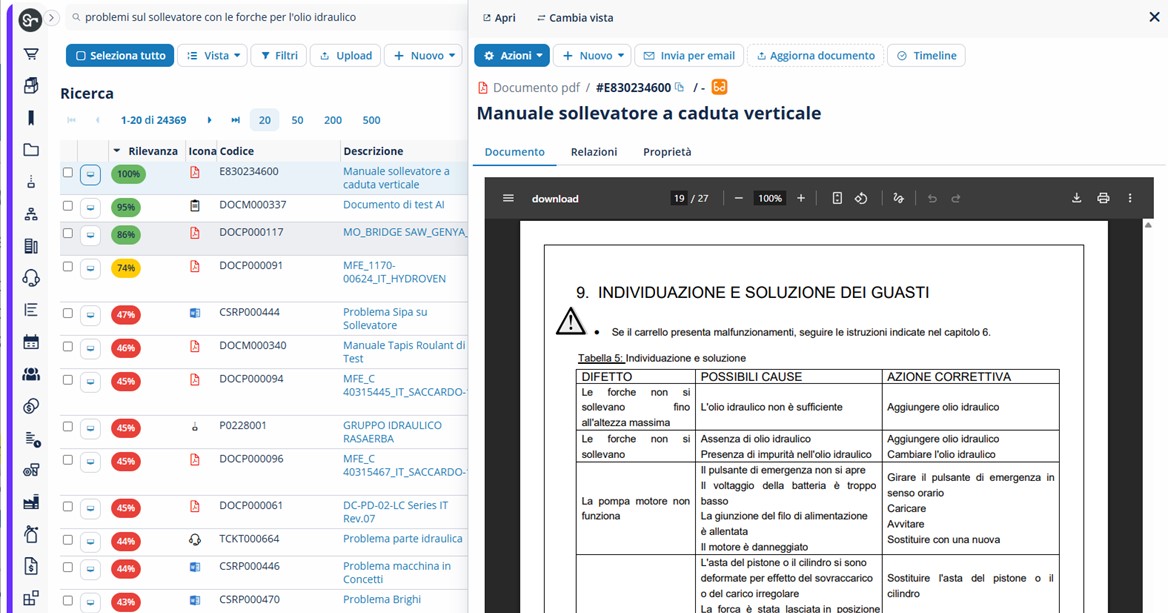
Search has always been one of SolidRules’ strengths. Thanks to its powerful indexing system, you can find any information within documents such as PDFs, DWGs, emails, quotes, orders, and much more.
Today, with the arrival of the new Artificial Intelligence Layer, search becomes even more intelligent and precise.
Even when the words you type don’t exactly match those in the documents, whether singular, plural, or synonyms, Ask SolidRules can still identify the correct file and open it directly to the relevant page. This feature also works across multiple languages.
In short, finding what you’re looking for has never been easier.
Similar Item Search
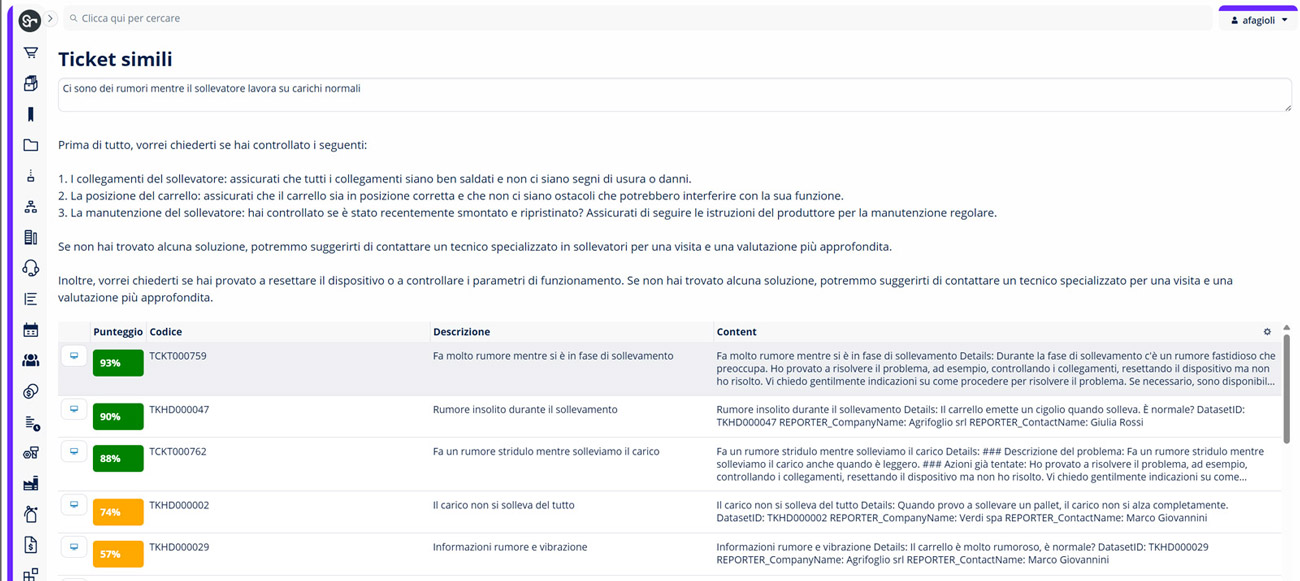
Following the same logic as document search, SolidRules now allows you to identify similar entities even when they are expressed in different ways.
This feature is designed to make searches (for Tickets, Projects, Tasks, etc.) faster and more precise, improving overall work efficiency.
But it doesn’t stop at tickets: the same approach can be applied to any type of content.
Morphological Search
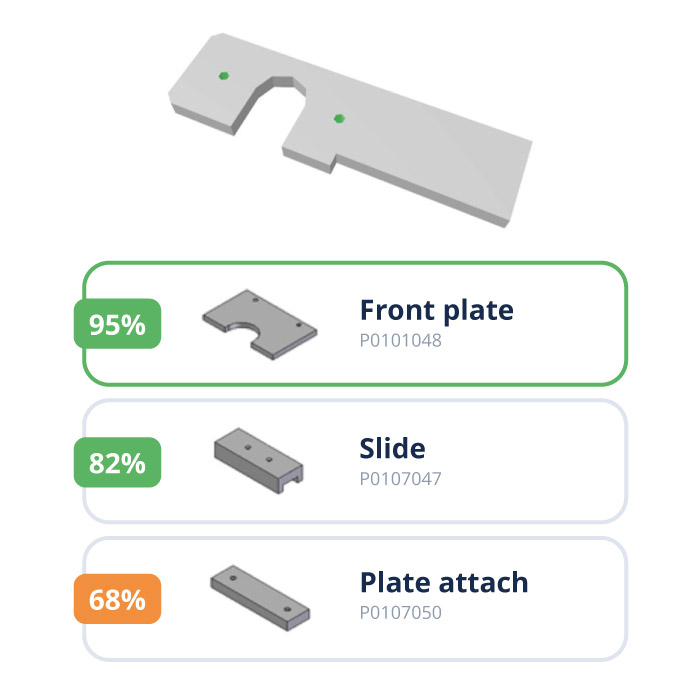
Morphological search is particularly effective in PDM, allowing you to find components, bills of materials, or related files even if their names or descriptions vary slightly.
Morphological similarity search is an essential component of modern AI, enabling a deep, context-aware understanding of data. By analyzing internal structures, it can identify similarities that go beyond superficial matches, enabling smarter and more adaptive applications.
Document Analysis and Summarization via Chat
Ask SolidRules doesn’t work as a separate search, it is fully integrated within SolidRules.
Once a document is selected, you can ask Ask SolidRules to summarize it or analyze it in depth, turning the chat into a powerful tool for quickly navigating and understanding content. This also applies to the history of an entity, such as a complex order or a project that has lasted for years.
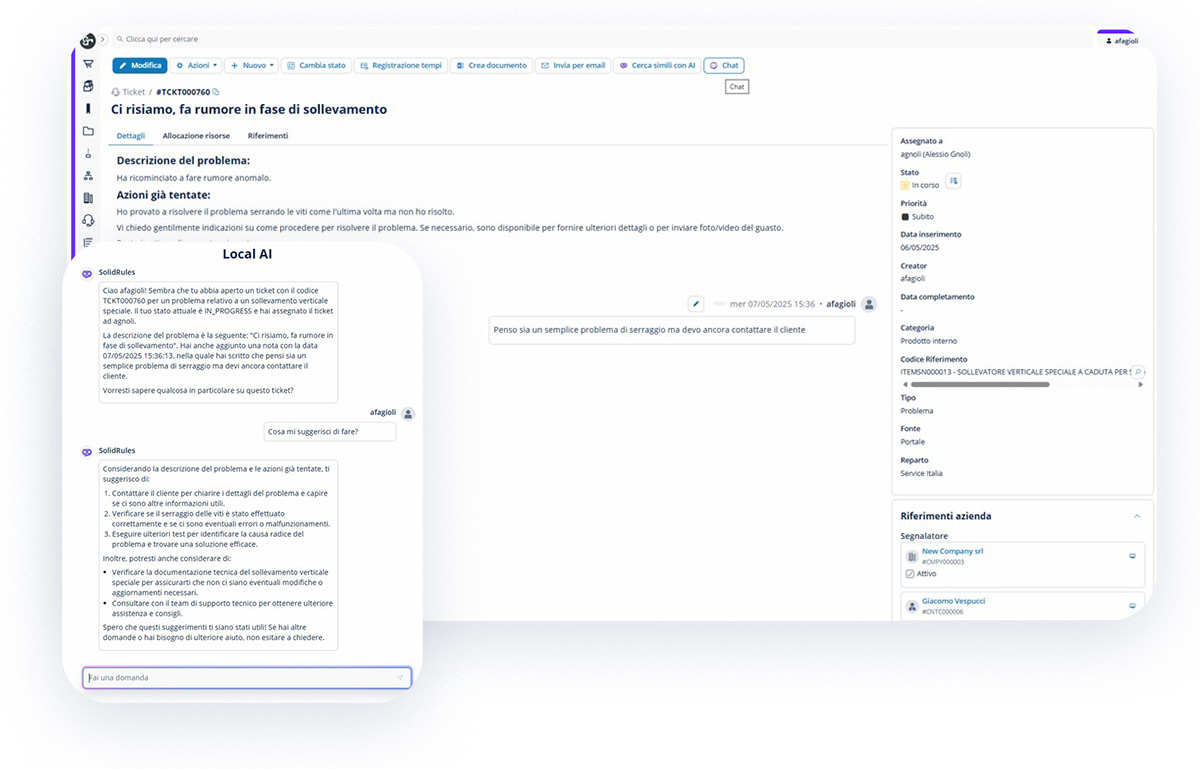
Virtual Assistant: 24/7 Support and Smart Sales
SolidRules offers an intelligent virtual assistant that provides continuous support, 24/7, especially in the Service area. A true AI conversational agent that handles support requests, resolves common issues, and can autonomously create tickets or escalate cases.
This tool centralizes all company know-how, helping users solve problems without opening unnecessary tickets, making support faster and more efficient.
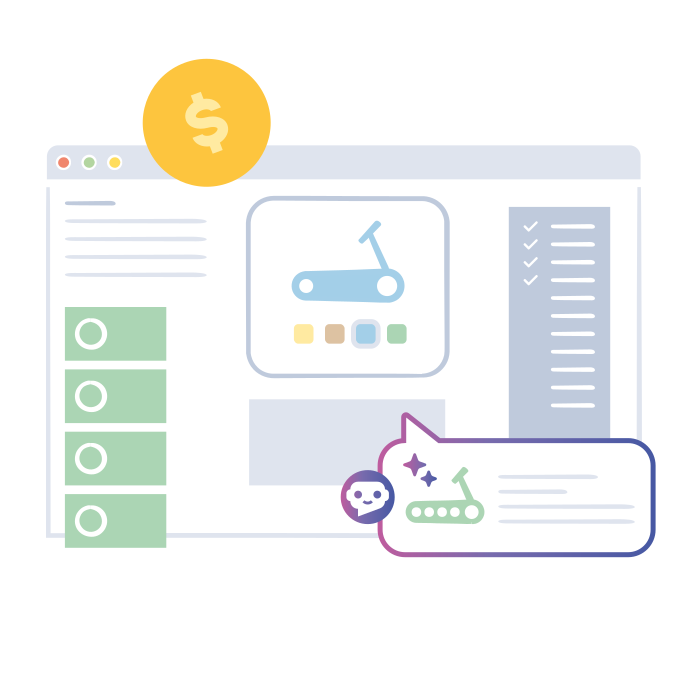
But the assistant doesn’t stop at support: it also becomes a sales ally, an AI agent specialized in commercial operations. In the CPQ, it guides the configuration of complex products and suggests optimal setups, like positioning objects in a 3D virtual environment, just as an experienced salesperson would, enhancing the customer experience and accelerating the sales process.
The AI agent can also calculate prices and generate personalized quotes.
Frequently asked questions
-
1. How is data protected?
Customer data remains fully isolated within SolidRules. The AI operates in a local, controlled environment designed for enterprise use, with no data sharing between customers.
In addition, customer information is not used to train external models, ensuring full confidentiality and data protection.
This architecture guarantees a secure environment where organizations maintain complete control over their data at all times.
-
2. Which AI model is used?
The solution is based on a local AI approach. The most suitable models are selected depending on the specific business objectives and then deployed directly within the company’s own infrastructure.
This ensures maximum privacy and control, as no data leaves the organization. The system does not rely on third-party cloud AI services and does not require per-query token-based costs.
The solution can be deployed in on-premise or private cloud environments, fully hosted within the customer’s IT infrastructure, and is capable of managing millions of documents and billions of data points.
In addition, the AI can operate even in offline mode, ensuring continuity, security, and independence from external connectivity.
This architecture is designed to provide scalability, data sovereignty, and long-term cost efficiency.
-
3. Is AI suitable for complex and engineer-to-order products?
Yes. AI is particularly well suited for complex Engineer-to-Order (ETO) and highly configurable products, where engineering is a central part of the process and multiple disciplines (mechanical, electrical, software) and many variables are involved.
In SolidRules, AI acts as a powerful ally in managing product variants, technical rules, and complex decision-making processes.
AI is deeply embedded across the SolidRules platform and can accelerate activities such as design, configuration, quotation, and maintenance, while reducing errors and operational time.
The result is a more efficient and reliable way to handle complexity throughout the entire product lifecycle.
-
4. What is the key strength of Artificial Intelligence in SolidRules?
Thanks to AI, search capabilities, already one of SolidRules’ strongest features due to its advanced indexing technology, become even more powerful and accurate.
Users can quickly find information within PDFs, CAD drawings (DWG), emails, quotations, orders, and many other types of documents. The system can identify relevant content even when the search terms do not exactly match the words contained in the documents, recognizing singular and plural forms, synonyms, and contextual meanings.
For example, a user can ask a question in Polish and retrieve the answer from an Italian manual, opening the document directly on the most relevant page.
Productivity is further enhanced by advanced similarity search and geometric shape recognition capabilities—particularly effective within the PDM environment. These features enable a deep semantic understanding of both documents and engineering data, allowing the system to interpret the intent behind a search rather than simply matching keywords.
The result is faster access to information, reduced time spent searching, and more effective reuse of existing knowledge across the organization.
Any question? We are here for you.
Fill out the form or send us an email to info@solidrules.com. We will contact you to provide you all the solutions.